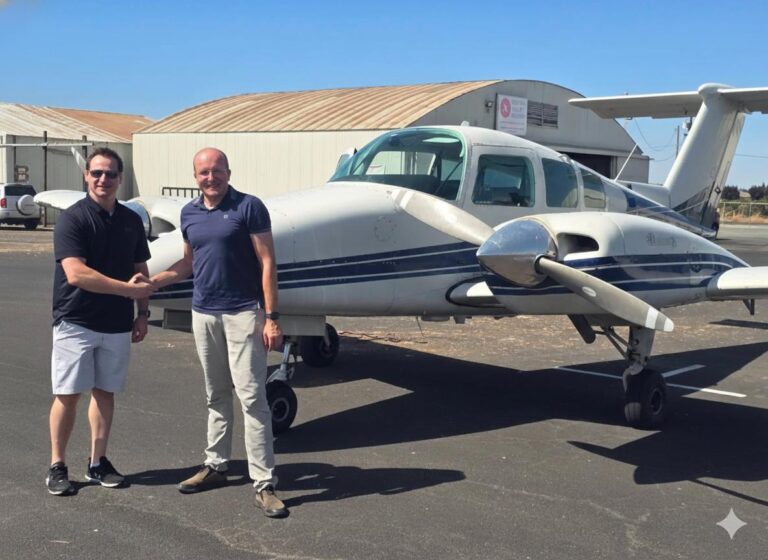
Commercial Pilot Certification | The Right Way to Advance Your Aviation Career
Advance from private and instrument training into professional-level flying with structured commercial pilot training.
This is where pilots transition from learning to fly… to flying with precision, consistency, and professional standards.
What's Included
- Ground training
- Flight training
- Pre/Post Briefings
- FAA Approved Online Classes
- Your Pace or Fast (Accelerated)
- Airplane rental for the training and the checkride
Fixed Cost
What Is a Commercial Pilot License?
A commercial pilot certificate allows you to:
- be compensated for flying
- operate at a higher level of precision
- begin building real-world experience
More importantly, this phase develops:
- advanced aircraft control
- consistency and standards
- professional-level decision-making
This is where pilot training becomes career training.
Most pilots begin their journey with private pilot training before progressing into instrument and commercial phases.
Commercial Pilot Training Paths
There are two primary ways to complete your commercial training:
Option 1: Single Engine First (ASEL)
- Most common path under Part 141
- Build strong foundational skills
- Add multi-engine later
👉 Required for Part 141 progression at CFI Academy
Option 2: Multi-Engine First (AMEL)
- Possible under Part 61
- Direct exposure to multi-engine operations
- Often used in specific career strategies
👉 Requires careful planning to avoid inefficiencies
If you plan to go for flight instructor path after your commercial pilot, you may want to look at our commercial pilot plus CFI training course.
Part 61 vs Part 141 Commercial Training
Commercial pilot training can be completed under either:
Part 141 (Structured Path — Recommended for Most)
- Commercial completed in 190 total hours
- Structured, stage-based progression
- Standardized instruction
- Strong preparation for instructor or airline paths
👉 This is the primary structure used at CFI Academy
Part 61 (Flexible Path)
- Requires 250 total hours
- Allows flexibility in training order
- Can complete ASEL or AMEL first
Key Differences That Matter
- Instrument training under Part 141 does NOT require 50 hours cross-country PIC
- Part 61 does require it
- Training sequence flexibility vs structure
👉 Learn more: Part 61 vs Part 141 flight training
Why Training Structure Matters
This is where many pilots make costly mistakes.
Poor planning leads to:
- unnecessary hours
- higher total cost
- inefficient progression
Structured planning leads to:
- faster completion
- better skill development
- smoother transition into instructor or airline path
What matters more than price: The quality of your foundation.
Before committing to a training sequence, we strongly recommend reviewing the smartest path to becoming an airline pilot.
Commercial Pilot Program Overview
Training Includes:
- advanced flight maneuvers
- complex aircraft operations
- cross-country flying
- commercial-level standards
- checkride preparation
Aircraft:
- Cessna 172 / Piper PA-28 (ASEL)
- Multi-engine aircraft (AMEL add-on)
Typical Timeline:
- 3–6 weeks (accelerated phase)
- varies based on experience
Commercial Pilot Training Cost
Estimated investment:
- ASEL: $5,000 – $15,000
- Multi-engine add-on: additional cost
Actual cost depends on:
- starting experience
- training consistency
- path selected
Your Next Step After Instrument Training
Commercial pilot training typically follows instrument rating training as the next step in your progression.
From here, most students choose:
Path 1: Commercial + CFI (Most Common)
- Become a flight instructor
- build hours efficiently
- progress toward airlines
Path 2: Multi-Engine First (Selective Strategy)
- direct multi-engine focus
- part of certain professional pilot programs
One of the most important decisions at this stage is choosing between CFI vs multi-engine first, which affects both cost and timeline.
This Program Is Designed for Serious Pilots
This program is best suited for individuals who:
- Are considering aviation as a career
- Plan to continue into professional pilot careers
- Want structured, high-quality instruction from day one
- Value long-term success over shortcuts
Most of our students are not stopping at private, they are following a structured professional pilot training path designed for long-term progression.
Part 141 requires 190 hours, while Part 61 requires 250 hours.
Yes, under Part 61 you can complete AMEL first, but most structured programs begin with ASEL.
Most students continue into flight instructor training or structured professional pilot programs.
Part 141 offers structured progression and reduced total hours, while Part 61 offers flexibility.
Typically 3-6 weeks in an accelerated environment, depending on experience.
Why Train at CFI Academy
CFI Academy specializes in training flight instructors.
That means:
- higher training standards
- better preparation for teaching and professional flying
- stronger long-term outcomes
This same philosophy is applied across all of our flight instructor training programs, which is why our students are better prepared.
Your Training Path Starts Here
Commercial pilot training is only one step. A typical progression:
Private Pilot
→ Instrument Rating
→ Commercial Pilot
→ Flight Instructor (CFI)
→ Airline Career
Planning Your Training
Before starting, most students want clarity on:
Students often need clarity on:
- training sequence
- cost and financing
- timeline to career
- degree options
👉 Explore flight training financing options
👉 Learn how to earn a college degree while training (UVU)
Start With a Training Evaluation
Before enrolling, we take the time to evaluate:
- your current experience
- your goals
- the most efficient training path
This ensures we recommend the right training structure from the start.
Many students who start here ultimately continue into flight instructor training as the next step in their progression.
Ready to Move Forward?
Since 1998
CFI Academy has operated with a singular focus:
training professional flight instructors.
That focus shapes every program we offer—including private pilot training.