Private Pilot Certification | The Right Way to Start Your Aviation Career

At CFI Academy, private pilot training is not treated as a standalone course. It is the foundation of a structured training pathway designed for serious students who intend to progress into advanced ratings, flight instruction, and ultimately professional aviation.

Start your aviation journey the right way, with structured training designed for serious students who plan to go beyond the basics.

What's Included

Fixed Cost

What Is Private Pilot Training?

Private pilot training is the first step in becoming a licensed pilot. It teaches you how to safely operate an aircraft, navigate, communicate, and make sound decisions in real-world flight conditions.

By the end of your training, you will:

  • Be legally licensed to fly as Pilot in Command
  • Carry passengers (non-commercial)
  • Build the foundation for advanced ratings

This is where everything begins; but how you train here determines everything that follows.

If your goal is to continue beyond the private level, understanding the full pathway early is critical—especially if you’re planning how to become an airline pilot.

This Program Is Designed for Serious Students

This program is best suited for individuals who:

  • Are considering aviation as a career
  • Plan to continue into Instrument, Commercial, and Instructor training
  • Want structured, high-quality instruction from day one
  • Value long-term success over shortcuts

Most of our students are not stopping at private, they are following a structured professional pilot training path designed for long-term progression.
This program is not designed for casual or recreational flying.
We are selective because our goal is to train pilots who are prepared to succeed beyond the private level.

How to Get Your Private Pilot License

The process typically involves:

  1. Ground training (aerodynamics, regulations, weather, navigation)
  2. Flight training with a certified instructor
  3. Solo flight experience
  4. FAA knowledge (written) exam
  5. Final practical test (checkride)

We guide you through each step in a structured and efficient way.

You can review the official FAA private pilot requirements to better understand the eligibility and training structure.

Yes. But you must complete the TSA verification process. You can read in detail the DHS/TSA requirements, or simply visit the TSA web site and register as a “Candidate” for the Alien Flight Student Training Program. Select CFI Academy. as your course provider. TSA approval must be granted before you begin training. TSA approval is required for all non-citizens, even if you have a green card and are a legal U.S. resident.

Most students complete private pilot training in 2 to 4 months, depending on consistency and schedule. Accelerated training can be completed in as little as 4-8 weeks.

Private pilot training typically costs between $12,000 and $18,000. The total cost depends on your starting proficiency, training frequency, and aircraft used.

No, a degree is not required to become a private pilot or even a commercial pilot, though some airlines prefer one.

Yes, but full-time students complete training faster and often more efficiently.

Both are valid, but many students benefit from Part 141 due to its structured curriculum and standardized training approach. We help determine the best option based on your goals.

Do Airlines care whether you did part 61 or 141? No. But they do care about the quality of the training.

Yes. Private pilot training is the first step in the full pathway toward becoming an airline pilot, followed by instrument, commercial, and instructor training.

Part 61 vs Part 141 — How We Structure Your Training

This program may be conducted under either Part 61 or Part 141, depending on your background, goals, and timeline.

  • Part 61 (flexible structure)
  • Part 141 (structured curriculum)

For a deeper breakdown, see our full comparison of Part 61 vs Part 141 flight training.

Why Part 141:

  • Structured, stage-based progression
  • Standardized curriculum
  • Consistent instructor methodology
  • Built-in quality control through stage checks
  • Better preparation for advanced training

When Part 61 may be appropriate:

  • Flexible scheduling needs
  • Prior training or experience
  • Specific individual circumstances

We don’t force a structure; we recommend the one that produces the best outcome for your situation.

We evaluate your situation and recommend the best path, not a one-size-fits-all approach.

Why Start Your Training at a Flight Instructor School

CFI Academy is not a typical flight school.

Since 1998, our primary focus has been training flight instructors. That focus directly impacts how we train private pilot students.

You will:

  • Learn concepts at a deeper level
  • Develop strong decision-making habits early
  • Avoid weak foundational training
  • Be prepared for advanced ratings from the start

We don’t just train you to pass a checkride.
We train you to become a better pilot long-term.

This is the same philosophy we apply across all of our flight instructor training programs, which is why our students are better prepared as they progress.

How Long Does Private Pilot Training Take?

Your timeline depends on consistency and schedule.

Typical timelines:

  • Accelerated: 4-8 weeks (full-time, prepared students)
  • Standard: 2-4 months

The most important factor is training consistency, not just total hours.

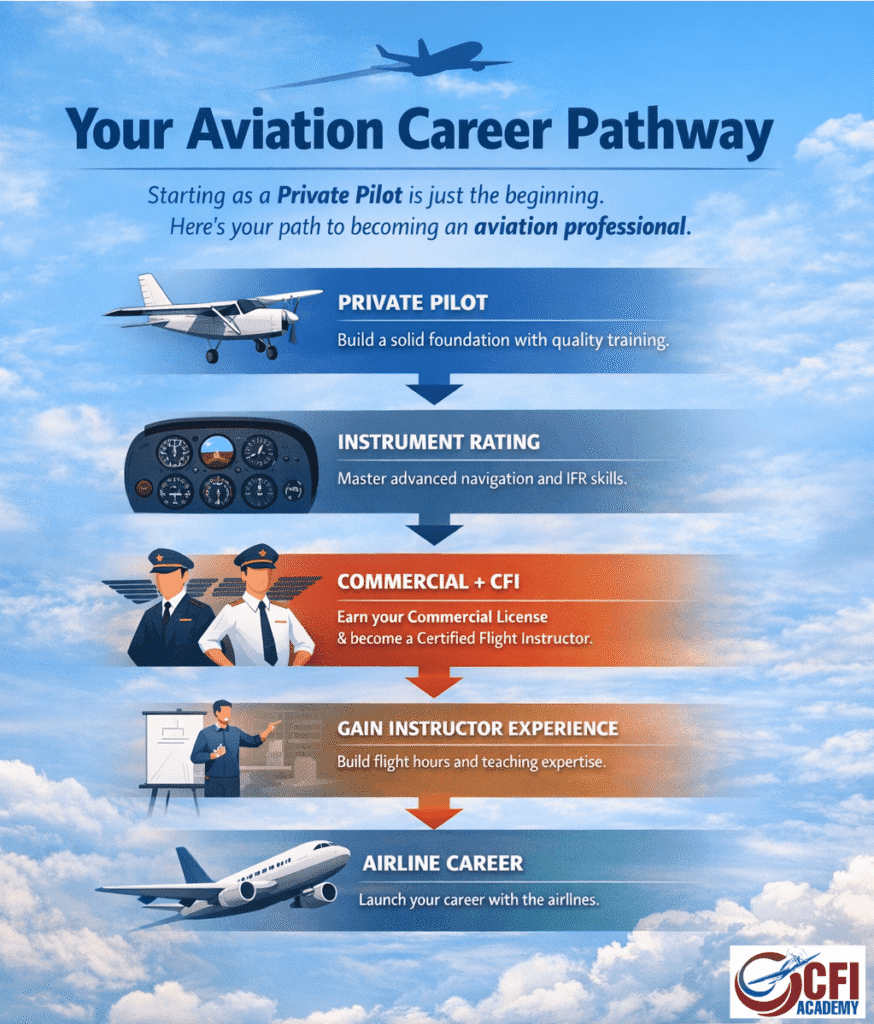
Infographic titled Your Aviation Career Pathway, outlining steps to becoming an aviation professional: starting as a private pilot, earning an Instrument Rating, advancing to Commercial + CFI, gaining instructor experience, and pursuing an airline career with related images. - CFI Academy

Your Training Path Starts Here

Private pilot training is only the first step. A typical progression:

Private Pilot
→ Instrument Rating
→ Commercial Pilot
→ Flight Instructor (CFI)
→ Airline Career

If you are planning long-term, it’s important to understand how long it takes to become an airline pilot from start to finish.

We strongly recommend reviewing the smartest path to becoming an airline pilot before deciding how to structure your training.

One of the biggest decisions students face is choosing between CFI vs multi-engine first, and this choice impacts both timeline and cost.

Private Pilot Training Cost

Estimated total investment:
Approximately $12,000-$18,000*

*This is an estimate. Actual cost depends on:

  • your starting proficiency
  • training pace
  • consistency of schedule

What matters more than price:
The quality of your foundation.

Poor early training leads to:

  • delays later
  • higher total cost
  • weaker performance in advanced courses

Many students plan for Instrument Rating training and certification next.

Planning Your Training

Before starting, most students want clarity on:

  • financing options
  • timeline to career
  • whether to combine training phases
  • how to structure the full path

👉 Explore flight training financing options
👉 Learn how to earn a college degree while training (UVU)

Start With a Training Evaluation

Before enrolling, we take the time to understand:

  • your background
  • your goals
  • your long-term plan

This ensures we recommend the right training structure from the start.

If you are in the early stages of exploring the training path for yourself, you can visit our flight training courses offered page.

Since 1998

CFI Academy has operated with a singular focus:
training professional flight instructors.

That focus shapes every program we offer, including private pilot training.

Testimonials

What Our Students Say

A smiling Flight Instructor wearing a headset sits in an airplane cockpit, holding the controls and looking forward, surrounded by illuminated flight instruments and equipment. Perfect for those pursuing an Accelerated CFI path. - CFI Academy

The Art of Communication: Radio Procedures for Pilots

Effective communication is the backbone of aviation safety. Pilots rely on clear and concise radio procedures to exchange critical information with air traffic control (ATC) ...
A vintage biplane is parked on an empty airport runway at sunset, with dramatic clouds and a colorful sky in the background—perfect inspiration for any aspiring Flight Instructor or Accelerated CFI. - CFI Academy

Weather Wisdom: How to Interpret Weather Data for Safer Flights

Weather plays a pivotal role in aviation safety, and understanding weather data is essential for every pilot. The ability to interpret weather information can mean ...
A man wearing sunglasses, a grey hoodie, and dark pants stands in front of a small red and white single-engine airplane, embodying the cool confidence of an Accelerated CFI against the backdrop of dry hills and clear skies. - CFI Academy

Swaraj Sandhu

Best place to do your CFI training.. best instructors I have had throughout my pilot training. I’m really happy I chose this place to get ...

A Certificated Flight Instructor wearing sunglasses, a headset, and a white uniform shirt with black stripes on the shoulders is sitting in the cockpit of an aircraft, smiling at the camera. - CFI Academy

Byeomseok Jeon

What I love about CFI Academy is that you’re taught the why and you have to be able to explain the why. It’s challenging but ...

A young man wearing glasses, a suit, and a striped tie stands confidently in front of a white airplane under a clear blue sky, embodying the professionalism of an Accelerated CFI (Certificated Flight Instructor). - CFI Academy

Roger Chen

I spent two and half weeks at CFI Academy. The environment is casual but the material is not. Prince is the lead instructor and the ...

A smiling Flight Instructor in sunglasses and a gray hoodie with orange lettering stands next to a small airplane on a sunny day. - CFI Academy

Nate Early

You can probably learn just as much anywhere else you go, but I can promise you, you won’t be ready to TEACH like you would ...
From Our Blog

Educational Resources