Becoming a Certified Flight Instructor (CFI) is one of the most important milestones in the professional pilot pathway. Flight instructors are responsible not only for teaching pilots how to fly, but also for shaping the safety culture and decision-making habits that influence aviation for decades.
For many pilots, becoming a flight instructor is the stage where technical knowledge truly matures. Teaching others requires a deeper understanding of aerodynamics, regulations, aircraft systems, and risk management than simply passing a checkride.
This guide explains the complete process of becoming a flight instructor, including training requirements, certification steps, and the role instructors play in the aviation industry.
Steps to Become a Flight Instructor
- Earn a Commercial Pilot Certificate
- Study and pass the Fundamentals of Instruction (FOI) knowledge test
- Pass the Flight Instructor knowledge test
- Complete CFI flight training and lesson preparation
- Receive spin training and endorsement
- Pass the FAA CFI practical test or End-of-course under Part 141 Examining Authority (checkride)
- Begin teaching as a Certified Flight Instructor
Steps to Become a Flight Instructor
The process of becoming a Certified Flight Instructor typically follows these steps:
Earn a Commercial Pilot Certificate
Pass the Fundamentals of Instruction (FOI) knowledge test
Pass the Flight Instructor knowledge test
Complete instructor flight training and lesson planning preparation
Receive spin training and endorsement
Pass the FAA CFI practical test with a Designated Pilot Examiner (DPE) or through a Part 141 school with examining authority
Begin working as a Certified Flight Instructor
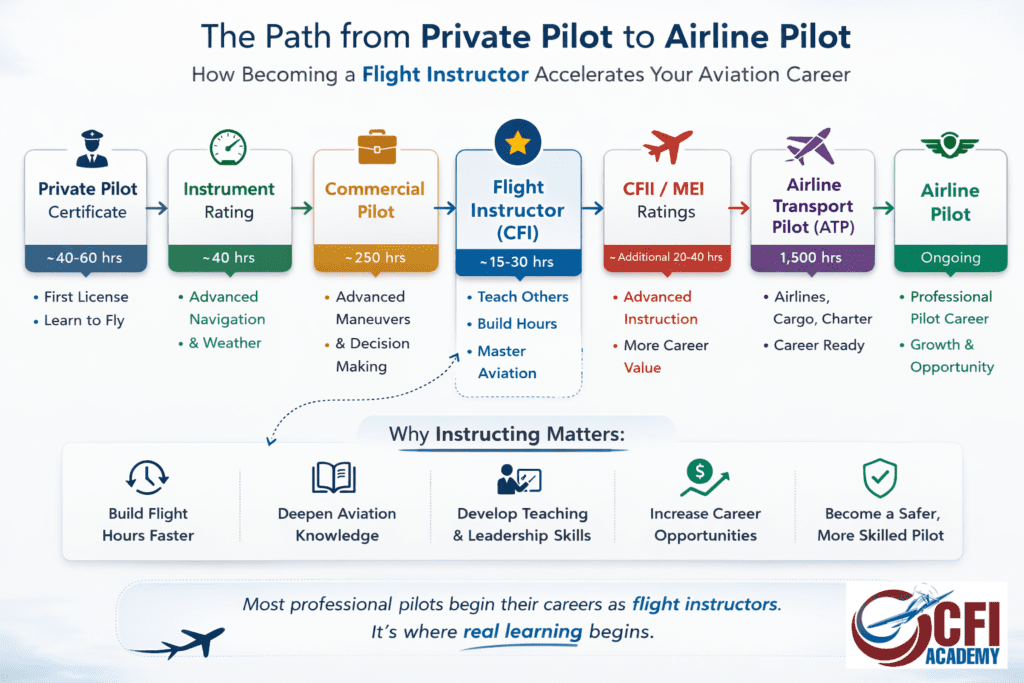
What Is a Certified Flight Instructor?
A Certified Flight Instructor is a pilot authorized by the FAA to provide flight training and endorsements to student pilots and other certificate applicants.
CFIs teach a wide range of skills, including:
aircraft control and maneuvering
navigation and flight planning
aeronautical decision-making
safety procedures and regulations
More importantly, instructors help students develop judgment and discipline in the cockpit.
Strong instructors combine technical knowledge with effective teaching skills. The qualities that define successful instructors are explored in our article on what makes a great flight instructor.
Minimum Requirements to Become a CFI
To qualify for a flight instructor certificate in the United States, pilots must meet several FAA requirements.
Basic prerequisites include:
Holding at least a Commercial Pilot Certificate
Being 18 years of age or older
Being able to read, speak, write, and understand English
Passing the Fundamentals of Instruction (FOI) knowledge test
Passing the Flight Instructor knowledge test
Completing spin training and receiving a spin endorsement
Passing the CFI practical test (checkride) or End-of-Course check (Part 141 Examining Authority)
These requirements ensure that instructor candidates possess both technical proficiency and the knowledge required to teach effectively.
Step 1: Complete Commercial Pilot Training
Before pursuing a flight instructor certificate, pilots must obtain a Commercial Pilot Certificate.
Commercial training builds the foundation of advanced piloting skills and aeronautical knowledge. During this stage, pilots develop stronger aircraft control, navigation ability, and operational decision-making.
Many pilots also begin to develop an interest in teaching during this phase, particularly when working closely with experienced instructors.
Understanding how airlines evaluate pilots can also be helpful at this stage. Our article on what airlines actually look for in new pilot hires explores how instructors often fit into the professional pilot career pathway.
Step 2: Study the Fundamentals of Instruction (FOI)
One of the most unique aspects of instructor training is the Fundamentals of Instruction (FOI).
Unlike earlier training phases, FOI focuses on how people learn.
Instructor candidates study topics such as:
the learning process
effective teaching methods
human behavior and motivation
communication techniques
evaluation and feedback
These concepts help instructors understand how students absorb information and how to adapt teaching methods to different learning styles.
A deeper discussion of aviation learning principles can be found in our article learning is a change of behavior.
Step 3: Complete CFI Flight Training
CFI flight training differs significantly from earlier pilot training.
Instead of simply performing maneuvers, instructor candidates must learn to teach those maneuvers from the right seat of the aircraft.
Training typically includes:
teaching and demonstrating maneuvers
preparing and delivering lesson plans
explaining aerodynamics and aircraft systems
conducting pre-flight and post-flight briefings
learning how to evaluate student performance
This stage of training requires candidates to develop both technical understanding and teaching ability.
Many pilots find that instructor training is one of the most intellectually demanding phases of their aviation education. Our article CFI training: what it really takes explores the depth of preparation involved in instructor training.
Step 4: Pass the CFI Checkride
The final step in becoming a flight instructor is the CFI practical test, commonly referred to as the checkride.
The checkride includes two major components:
Oral Examination
The oral portion of the checkride is often extensive and may last several hours. During this phase, the examiner evaluates the instructor candidate’s ability to explain aviation concepts clearly and demonstrate strong knowledge of regulations, aerodynamics, and instructional techniques.
Flight Portion
During the flight portion, candidates must demonstrate maneuvers while simultaneously explaining them as if teaching a student pilot.
Examiners are evaluating not only flying ability but also instructional clarity and safety awareness.
In most cases, the CFI practical test is conducted by a Designated Pilot Examiner (DPE) authorized by the FAA. However, some FAA Part 141 schools operate under Examining Authority, which allows the school itself to conduct end-of-course tests and issue graduation certificates without relying on external examiners.
CFI Academy operates under FAA-approved Examining Authority for the CFI course, allowing qualified students to complete their end-of-course evaluation directly within the training program. This helps maintain consistent evaluation standards and reduces delays caused by limited examiner availability.
Pilots interested in understanding how examining authority works can learn more in our article What Is FAA Part 141 Examining Authority?
Step 5: Begin Teaching as a Flight Instructor
After successfully completing the checkride, pilots are issued their Certified Flight Instructor certificate.
Many new instructors begin teaching student pilots working toward their Private Pilot Certificate, while others teach instrument students or advanced ratings.
The early months of instructing are often when pilots gain some of their deepest aviation knowledge. Teaching requires explaining concepts repeatedly, diagnosing student errors, and continually refining one’s own understanding of aviation fundamentals.
This is one reason why instructor quality has such a significant impact on the aviation industry. The topic is explored further in our article why flight instructor quality determines the safety of the entire pilot pipeline.
Choosing the Right CFI Training Program
Selecting the right instructor training environment can have a significant impact on the development of a new instructor.
Strong instructor programs focus not only on passing the checkride, but on helping candidates develop the skills required to teach effectively.
Important factors to consider when evaluating training programs include:
instructor experience and mentorship
structured lesson planning and teaching preparation
emphasis on aeronautical knowledge
evaluation standards and training philosophy
Candidates comparing different regulatory training environments may also want to review Part 61 vs Part 141 flight instructor training.
Pilots comparing training environments may also find our guide on where should you do your CFI training helpful.
Pilots interested in pursuing instructor certification can learn more about the CFI training programs offered at CFI Academy.
Is Becoming a Flight Instructor Worth It?
For most professional pilots, becoming a Certified Flight Instructor is one of the most valuable stages of their aviation career. While many pilots initially pursue instructor certification as a way to build flight experience, the benefits extend far beyond accumulating flight hours.
Teaching aviation forces a pilot to develop a deeper understanding of aerodynamics, regulations, decision-making, and risk management. Explaining complex concepts to students requires instructors to truly master the material themselves. As a result, pilots who have spent time teaching often develop stronger knowledge, better cockpit discipline, and improved situational awareness.
Flight instruction also develops leadership and communication skills that are highly valued throughout the aviation industry. Many airline pilots credit their time as instructors with shaping their professionalism, cockpit resource management skills, and ability to mentor others.
For these reasons, flight instruction has long been considered one of the most effective ways for pilots to refine their skills while contributing to the development of safer aviators.
At CFI Academy, we believe instructor training should go far beyond preparing candidates for a checkride. The goal is to develop instructors who can teach effectively, mentor future pilots, and uphold the safety culture of aviation.
Frequently Asked Questions About Becoming a CFI
The timeline varies depending on a pilot’s experience and training environment. Pilots who already hold a Commercial Pilot Certificate typically complete CFI training in several weeks to a few months, depending on preparation and study time.
Pilots comparing different training environments may also find it helpful to understand the differences between Part 61 and Part 141 flight instructor training.
To qualify for a Certified Flight Instructor certificate, a pilot must hold at least a Commercial Pilot Certificate and pass both the Fundamentals of Instruction (FOI) knowledge test and the Flight Instructor knowledge test. Candidates must also complete instructor training and pass a practical test with an FAA examiner.
Yes. Many professional pilots build a significant portion of their early flight experience while working as flight instructors. Teaching allows pilots to log flight time, develop leadership skills, and strengthen their understanding of aviation.
CFI training is widely considered one of the most challenging phases of pilot training. Candidates must not only understand aviation concepts deeply but also learn how to teach those concepts effectively to students with different learning styles.
Yes. The purpose of CFI training is to prepare pilots to become effective instructors. However, successful instructors must be willing to study teaching methods, communicate clearly, and continually improve their instructional skills.
Continue Learning
Instructor training does not end with the checkride. Teaching others is one of the most effective ways to deepen understanding of aviation concepts.
Pilots interested in becoming flight instructors can explore additional resources in the Flight Instructor Training Knowledge Center, where we publish articles on instructor development, aviation teaching techniques, and professional pilot training.