Why This Question Is So Common and So Often Misunderstood
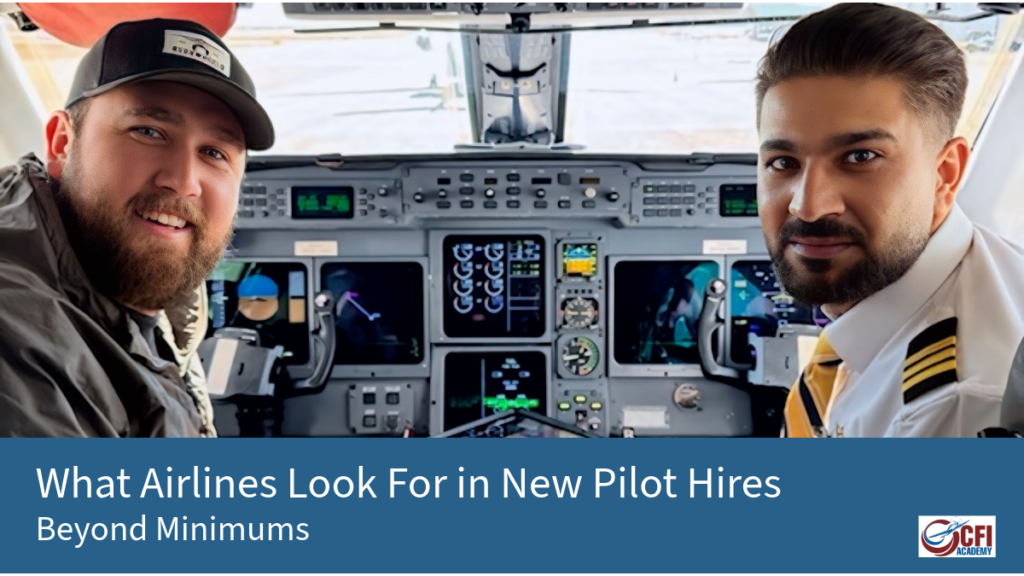
Aspiring airline pilots often focus on one question above all others:
“What do airlines actually look for when they hire pilots?”
Online answers tend to oversimplify the issue, usually by listing minimum flight hours or certificates. While those requirements matter, they are only the starting point, not the full picture.
Airline hiring decisions are shaped by training outcomes, not just checklists.
Meeting Minimums Is Not the Same as Being Competitive
Airlines publish minimum requirements for a reason: they establish a baseline.
But meeting minimums does not automatically make a candidate competitive.
Most airline new-hire classes include pilots who:
Exceed minimum experience
Demonstrate consistent training records
Adapt quickly to structured environments
Airlines are selecting for trainability, not just logbook totals.
Training Records Matter More Than Many Pilots Expect
Airlines look closely at training history.
This includes:
Checkride outcomes
Retraining events
Patterns of delay or inconsistency
Gaps in training continuity
One isolated issue is rarely disqualifying. Repeated problems that suggest weak fundamentals or poor preparation raise concerns.
Training quality tends to reveal itself over time.
Why Decision-Making and Judgment Carry Heavy Weight
Modern airline training environments are fast-paced and standardized.
Pilots who succeed tend to:
Understand why procedures exist
Demonstrate sound aeronautical decision-making
Remain adaptable under pressure
Learn from errors without repeating them
These qualities are developed through instruction and training culture, not memorization alone.
How Instructor Quality Shows Up in Airline Training
Airlines rarely ask candidates detailed questions about their flight instructors.
They don’t need to.
Instructor quality shows up indirectly through:
Learning efficiency
Simulator performance
CRM effectiveness
Ability to accept feedback
Pilots trained in consistent, instructor-standardized systems typically transition more smoothly into airline training programs.
Why Speed Alone Is Not a Hiring Advantage
Some candidates believe that finishing training as quickly as possible improves their prospects.
In reality:
Excessive acceleration can hide skill gaps
Rushed training increases retraining risk later
Airlines prefer consistency over speed
A slightly longer training timeline with strong fundamentals often produces better outcomes than rapid progression with uneven preparation.
The Role of Professionalism in Hiring Decisions
Professionalism extends beyond uniforms and logbooks.
Airlines assess professionalism through:
Interview preparation
Communication style
Attitude toward training
Willingness to accept responsibility
These traits are often shaped early, during primary and advanced training.
Degrees, School Names, and Brand Recognition
Despite persistent myths, airlines rarely prioritize:
The name of a flight school
Whether training occurred at a “big” or “small” program
Marketing claims about placement
Instead, airlines focus on:
How well candidates perform in training
How they adapt to airline procedures
Whether they demonstrate sound judgment
Education and school choice matter most in how they influence preparation, not prestige.
What Airlines Want to See Overall
Taken together, airlines are looking for pilots who:
Learn efficiently
Show consistent progress
Think systematically
Operate professionally
Transition smoothly into airline training
These qualities are built over time, through disciplined instruction and structured training environments.
Why This Perspective Matters for Students Early in Training
Understanding airline expectations early helps students:
Choose training environments wisely
Focus on fundamentals over shortcuts
Avoid decisions that create downstream problems
The best airline preparation often begins long before airline applications are submitted.
Next Step: Train for the Outcome You Want
Airline hiring is not a mystery, but it is often misunderstood.
Pilots who train within systems that emphasize consistency, decision-making, and instructional quality tend to be better prepared when airline opportunities arise.
Evaluating training programs through this lens can prevent costly missteps later.
Next Step
If you’re serious about an airline career, the fastest way to get clarity is a short strategy conversation. If you’d rather review how our program is structured first, start with the overview page.