Accelerated CFI training is often misunderstood.
For the right pilot, an accelerated program can be efficient, focused, and professionally transformative. For the wrong pilot, it can be frustrating, expensive, and unproductive.
The difference is not talent.
It is readiness, preparation, and mindset.
This article explains when accelerated CFI training works, and when it does not.
This discussion applies specifically to accelerated CFI training, where instructional readiness matters more than flight time alone.
What “Accelerated” Actually Means in CFI Training
Accelerated does not mean rushed.
In professional CFI training, accelerated means:
Condensed schedules
High daily expectations
Continuous evaluation
Minimal downtime between training events
Accountability for preparation before arrival
An accelerated environment assumes that foundational knowledge and study discipline already exist. The pace is designed to test and refine, not to introduce basic concepts slowly.
Why Some Pilots Thrive in Accelerated CFI Programs
Pilots who succeed in accelerated CFI training tend to share common traits.
They typically:
Arrive thoroughly prepared before day one
Study consistently and independently
Accept direct feedback without defensiveness
Adjust quickly when corrected
Treat training as a professional obligation, not a trial run
For these pilots, an accelerated format provides structure, momentum, and clarity. Progress feels intentional rather than prolonged.
Why Other Pilots Struggle
Accelerated CFI training exposes weaknesses quickly.
Pilots who struggle often:
Rely on last-minute preparation
Expect instructors to compensate for gaps in readiness
Have difficulty articulating concepts verbally
Resist critical evaluation
Confuse speed with effectiveness
These challenges are not moral failures. They simply indicate that the timing, or the training model, is not right yet.
Slowing the pace does not always solve the underlying issue. Preparation does.
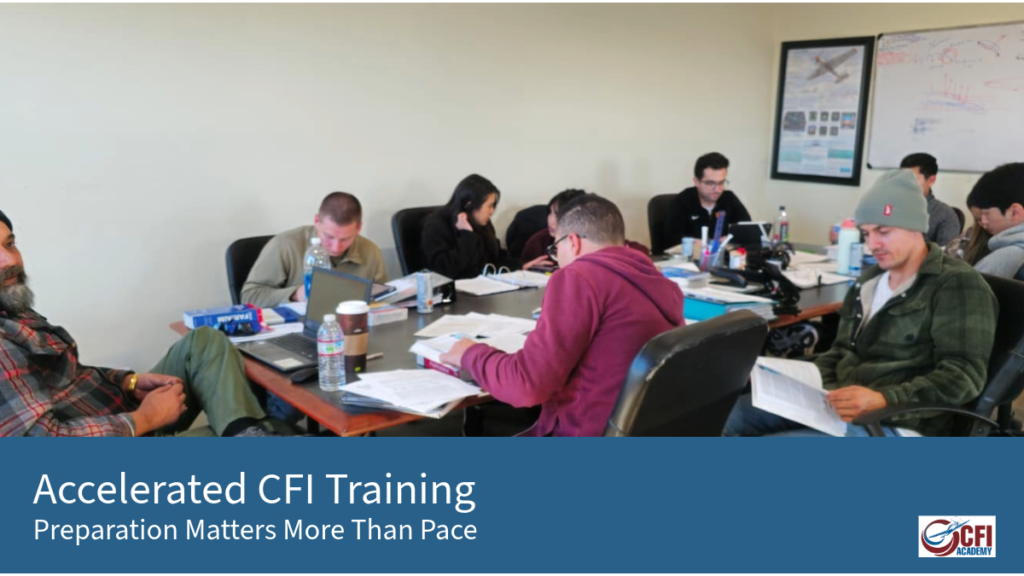
Preparation Matters More Than Pace
The most common mistake pilots make is assuming that an accelerated schedule will force readiness.
It does not.
Accelerated CFI training rewards:
Pre-arrival study
Familiarity with teaching concepts
Comfort explaining material aloud
Willingness to self-evaluate honestly
Pilots who prepare thoroughly often find the pace manageable. Pilots who do not prepare often feel overwhelmed regardless of how much time is available.
No training schedule can compensate for a lack of preparation in professional instructor training.
Many of the challenges in accelerated environments stem from gaps in professional CFI training fundamentals.
Accelerated vs. Rushed: A Critical Distinction
Rushed training cuts corners.
Accelerated training removes inefficiency.
Professional accelerated programs:
Maintain standards
Enforce preparation
Delay progression when readiness is not demonstrated
Prioritize instructional quality over speed
If a program promises speed without accountability, it is not accelerated – it is compromised.
This distinction is often misunderstood in discussions of Part 61 vs Part 141 instructor training, where structure matters more than the regulatory label.
When an Accelerated CFI Program Is the Right Choice
Accelerated CFI training is generally a good fit if you:
Have already committed to becoming a professional instructor
Can dedicate full attention to training during the program
Are comfortable operating under structure and pressure
Understand that progression is performance-based, not calendar-based
In these cases, an accelerated environment often produces clearer outcomes with less wasted time.
When It Is Not the Right Choice - Yet
An accelerated format may not be appropriate if you:
Are still building basic aeronautical knowledge
Struggle with independent study
Are unsure whether instruction is the right path
Expect training pace to compensate for lack of preparation
For these pilots, additional preparation before entering an accelerated program is usually the better investment.
How CFI Academy Approaches Accelerated Training
CFI Academy’s instructor programs are accelerated by design; but never rushed.
The training model emphasizes:
Clear readiness expectations
Structured daily objectives
Instructor standardization
Honest evaluation
Progression based on demonstrated competence
Acceleration exists to support focus and professionalism, not to lower standards.
This approach reflects how our flight instructor training programs are designed across all instructor certifications.
Making the Right Decision
Accelerated CFI training is not about proving toughness.
It is about matching the training environment to your level of readiness.
Pilots who choose correctly often describe the experience as demanding but efficient. Pilots who choose prematurely often wish they had prepared more before starting.
Being honest with yourself at this stage saves time, money, and frustration.
Next Step: Apply for Instructor Training
Instructor training at CFI Academy is selective. Applicants are evaluated for readiness before acceptance into accelerated instructor programs.
Apply for Instructor TrainingApplications are reviewed to determine fit before any training commitment is made.