Why Financing Is One of the Most Confusing Parts of Pilot Training
For many aspiring airline pilots, the biggest uncertainty is not whether they can fly—but how to pay for the training required to reach the airlines.
Online advice is often fragmented:
Some sources oversimplify financing
Others promote unrealistic solutions
Many fail to explain how financing interacts with training structure
Understanding what options actually work requires looking at the entire training system, not just loan products.
Financing decisions are best made in the context of the full training journey, which we outline in our guide on how to become an airline pilot in the United States.
The Reality: Most Airline Pilots Do Not Pay Everything Upfront
Very few professional pilots pay for their entire training out of pocket.
Instead, most combine multiple approaches over time, such as:
Personal savings
Income during training phases
Structured financing
Educational programs
The key is sequencing—not finding a single “perfect” solution.
Understanding financing options also requires a clear view of total expense, which we break down in our article on airline pilot training costs.
Personal Savings and Pay-As-You-Go Training
Using savings or income to fund portions of training can be effective, particularly early on.
Advantages include:
Reduced debt burden
Flexibility in pacing
Lower financial risk
Limitations include:
Slower progress
Longer overall timelines
Potential cost increases due to delays
This approach often works best when combined with other funding strategies.
Private Training Loans: Where They Help—and Where They Don’t
Private loans are commonly used in flight training, but they are not one-size-fits-all solutions.
Potential advantages:
Access to upfront capital
Ability to maintain training momentum
Important considerations:
Interest rates and repayment terms vary widely
Approval may depend on credit or cosigners
Borrowing too early can increase total cost
Loans tend to be most effective when paired with a realistic training plan and clear milestones.

Why Degree-Linked Financing Changes the Equation
For some students, integrating flight training with an academic program opens additional options.
Degree-linked pathways may allow access to:
Federal student aid
Structured repayment timelines
Greater financial predictability
This does not automatically reduce total cost, but it can significantly improve cash flow and flexibility—especially for career changers.
Working During Training as a Financing Strategy
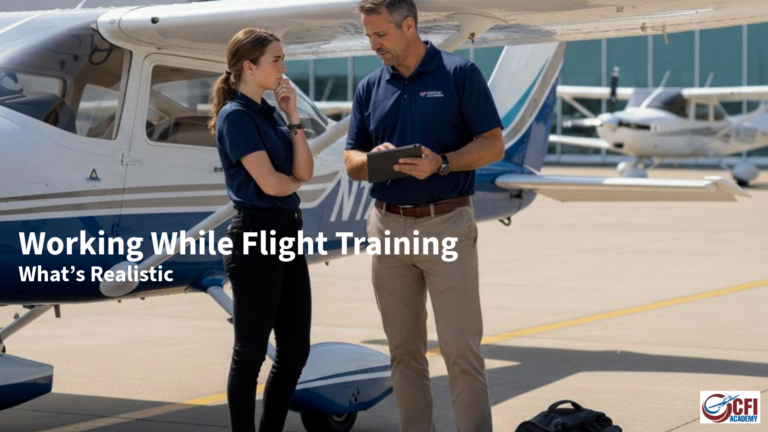
Income during training can play an important role in funding flight hours, particularly for students exploring whether they can work while becoming an airline pilot.
Common examples include:
Part-time work during early training
Full-time work during breaks or transitions
Instructing after certification
However, working excessively can slow progress and increase total cost if not managed carefully.
Financing decisions should always be evaluated alongside realistic timeline expectations.
The Hidden Cost of Poor Financing Decisions
The most expensive mistakes in flight training are rarely interest rates alone.
Common pitfalls include:
Underestimating total cost
Borrowing without a clear plan
Pausing training due to cash flow issues
Repeating training due to inconsistency
Each interruption adds time and cost—often more than the financing itself.
Interruptions caused by cash-flow issues often extend timelines, a dynamic we explain further in how long it really takes to become an airline pilot.
How CFI Academy Approaches Financing Conversations
CFI Academy does not sell loans or promote a single financing model.
Instead, discussions focus on:
Matching funding strategies to training phases
Understanding how cost, timeline, and work interact
Evaluating degree integration where appropriate
Avoiding over-commitment early in training
This approach helps students make informed decisions without unnecessary pressure.
What a Realistic Financing Plan Looks Like
Effective financing plans are:
Phased, not all-or-nothing
Aligned with training milestones
Flexible enough to adjust as progress changes
There is no universal solution—but there are many workable ones when planning is realistic.
Next Step: Build a Financing Strategy That Fits Your Situation
Financing flight training is a planning exercise, not a transaction.
A short strategy conversation can help you:
Understand realistic options
Sequence funding appropriately
Avoid costly interruptions
Align financing with long-term goals