When researching FAA-approved flight schools, you may come across the term “Examining Authority.”
For many students — especially those comparing Part 61 vs. Part 141 programs — this phrase can be confusing.
At CFI Academy, we specialize in professional pilot training, and this blog post breaks down exactly what Examining Authority is, why it matters, and how it affects your checkride experience and certification timeline.
Whether you’re pursuing your Private Pilot, Instrument Rating, Commercial Pilot Certificate, or CFI/CFII, understanding this concept will help you make better decisions throughout your training.
⭐ What Is Examining Authority (EA) Under Part 141?
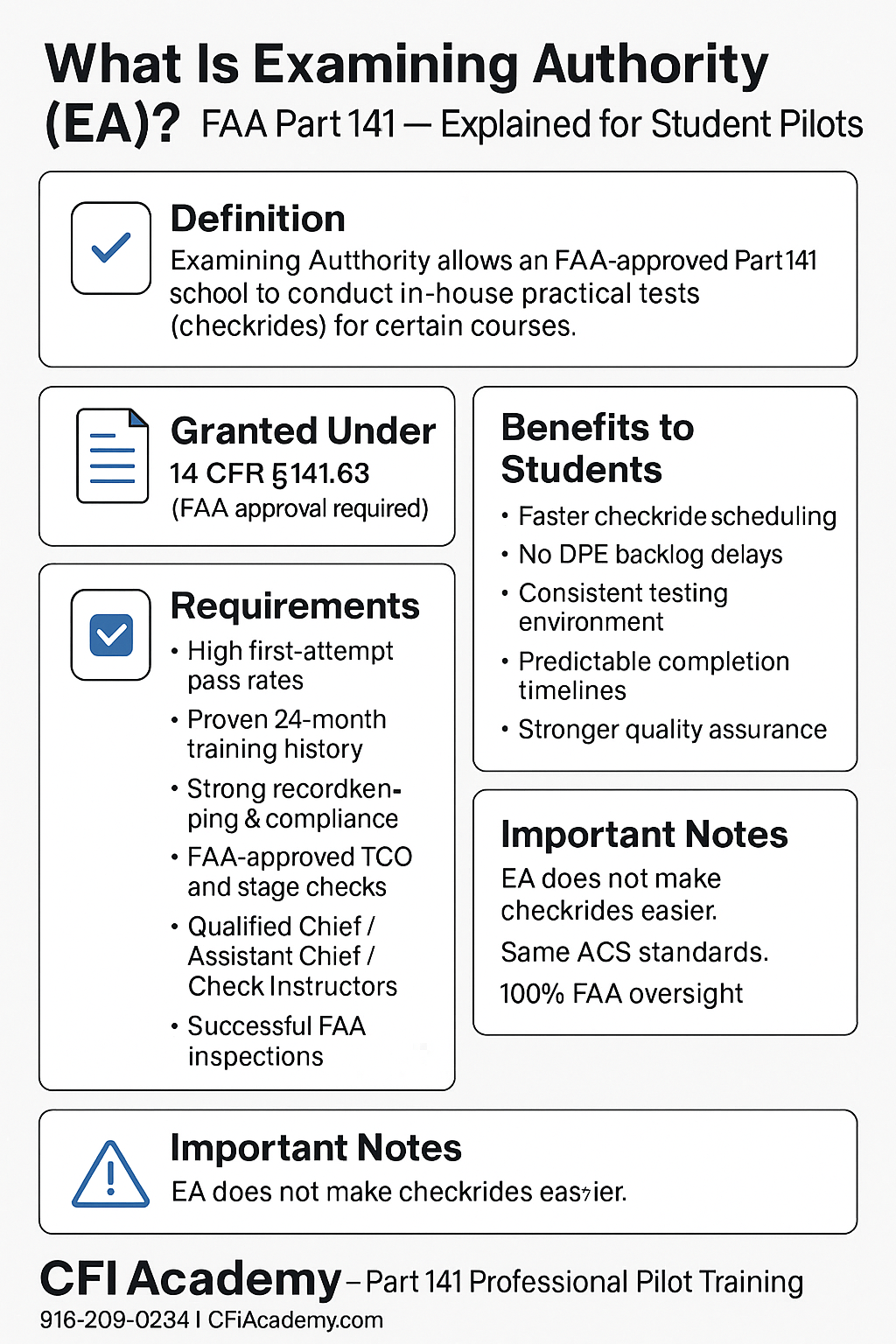
Examining Authority is an approval granted by the FAA to a Part 141 flight school that allows the school to conduct its own practical tests (checkrides) for certain courses, instead of requiring students to test with an outside DPE.
This authority is granted under 14 CFR §141.63, and it is considered a privilege, not a default status.
In simple terms:
A Part 141 school with Examining Authority is allowed to test its own graduates using internal evaluators, rather than waiting for a Designated Pilot Examiner (DPE).
This dramatically streamlines the training → testing → certification pipeline.
⭐ Why Does Examining Authority Exist?
The FAA created Examining Authority to:
Ensure high-performing flight schools can certify graduates efficiently
Reduce the burden on DPEs and FAA examiners
Improve scheduling and reduce delays
Standardize performance at schools with proven results
Only top-performing schools can earn this privilege — it is not automatically granted simply because the school is Part 141.
⭐ How Does a School Earn Examining Authority?
Under §141.63, the school must meet strict performance requirements, including:
✔ High Pass Rates
The school must show that students consistently pass FAA knowledge tests and practical tests on the first attempt.
✔ Stable Training Operations
The school must operate under FAA-approved curriculum (TCO), stage checks, and internal quality controls.
✔ Strong Recordkeeping & Compliance
Accurate training records, stage check documentation, student tracking, and instructor oversight are critical.
✔ Two-Year Performance History
The FAA evaluates at least 24 months of training results before issuing Examining Authority.
✔ Instructor Qualifications
Chief and assistant chief instructors must meet higher standards under Part 141.
✔ FAA Inspections & Oversight
The school must remain in good standing with its local Flight Standards District Office (FSDO).
Only after meeting all of these conditions will the FAA consider granting Examining Authority.
⭐ What Are the Benefits for Students?
Examining Authority provides several major advantages — especially in regions where DPE availability is limited.
1. Faster Checkride Scheduling
Students don’t have to wait weeks (or months) to find a DPE slot.
2. Consistent Testing Environment
The school’s internal evaluator uses the same curriculum and standard you trained with.
3. Smoother Training Flow
There is no gap between finishing training and taking the test, which reduces skill decay.
4. Predictable Timelines
Perfect for career-track students, international students, and those on fixed visas or schedules.
5. Higher Quality Control
Examining Authority is only granted to schools with proven high standards.
⭐ Who Conducts the Tests Under Examining Authority?
The FAA authorizes the school to designate internal evaluators, often one or more of the following:
Chief Flight Instructor
Assistant Chief Instructor
Check Instructor (141.37)
These individuals are approved by the FAA to administer the practical test only for students of their own school and only for courses for which Examining Authority has been granted.
This is different from a Designated Pilot Examiner (DPE), who is an independent evaluator authorized to test candidates from any school.
⭐ Does Examining Authority Mean Easier Checkrides?
No — and this is important.
A school with Examining Authority must:
Test to the exact same ACS/PTS standards
Maintain strict FAA oversight
Demonstrate consistent quality
Preserve examiner independence
Any failure to maintain these standards will result in loss of Examining Authority.
So while the process is more convenient, the testing standard is identical to that of a DPE.
⭐ How Long Does Examining Authority Last?
The FAA continuously monitors the school’s performance.
Examining Authority can be:
Expanded (to more courses)
Restricted
Suspended
Revoked
…based on performance, compliance, or quality issues.
High-performing schools maintain EA for years. Poorly performing schools lose it quickly.
⭐ Does CFI Academy Have Examining Authority?
This varies based on:
Which courses the FAA has approved
Current FAA evaluation cycles
Changes in regulations and oversight
School performance and growth
If you want the most current information on Examining Authority status for our courses, call us anytime:
📞 916-209-0234
🌐 CFIAcademy.com
We will tell you exactly:
Which courses qualify
How testing is scheduled
How mock checkrides fit in
How soon you can expect to test after completion
Transparency is everything.
⭐ Bottom Line: What Students Should Remember
Here’s the simple takeaway:
Examining Authority allows an FAA-approved Part 141 school to conduct in-house checkrides for certain courses — resulting in faster, more predictable certification timelines.
For students, that means:
Less waiting
Less stress
More consistency
Faster progression
A smoother path to becoming a professional pilot
If you’re evaluating flight schools, Examining Authority is a sign of excellence.
⭐ Interested in Part 141 Professional Pilot Training?
CFI Academy trains pilots for:
Airline Career Programs
…and we’re here to help you reach your aviation goals with confidence.
📞 916-209-0234
🌐 CFIAcademy.com
Click here for SPECIAL VERSION FOR INTERNATIONAL STUDENTS